
Case Studies:
What Support Can Look Like for Your Practice
Case Study 1: Pediatric Practice Revenue Cycle Assessment and Monthly Monitoring Results:
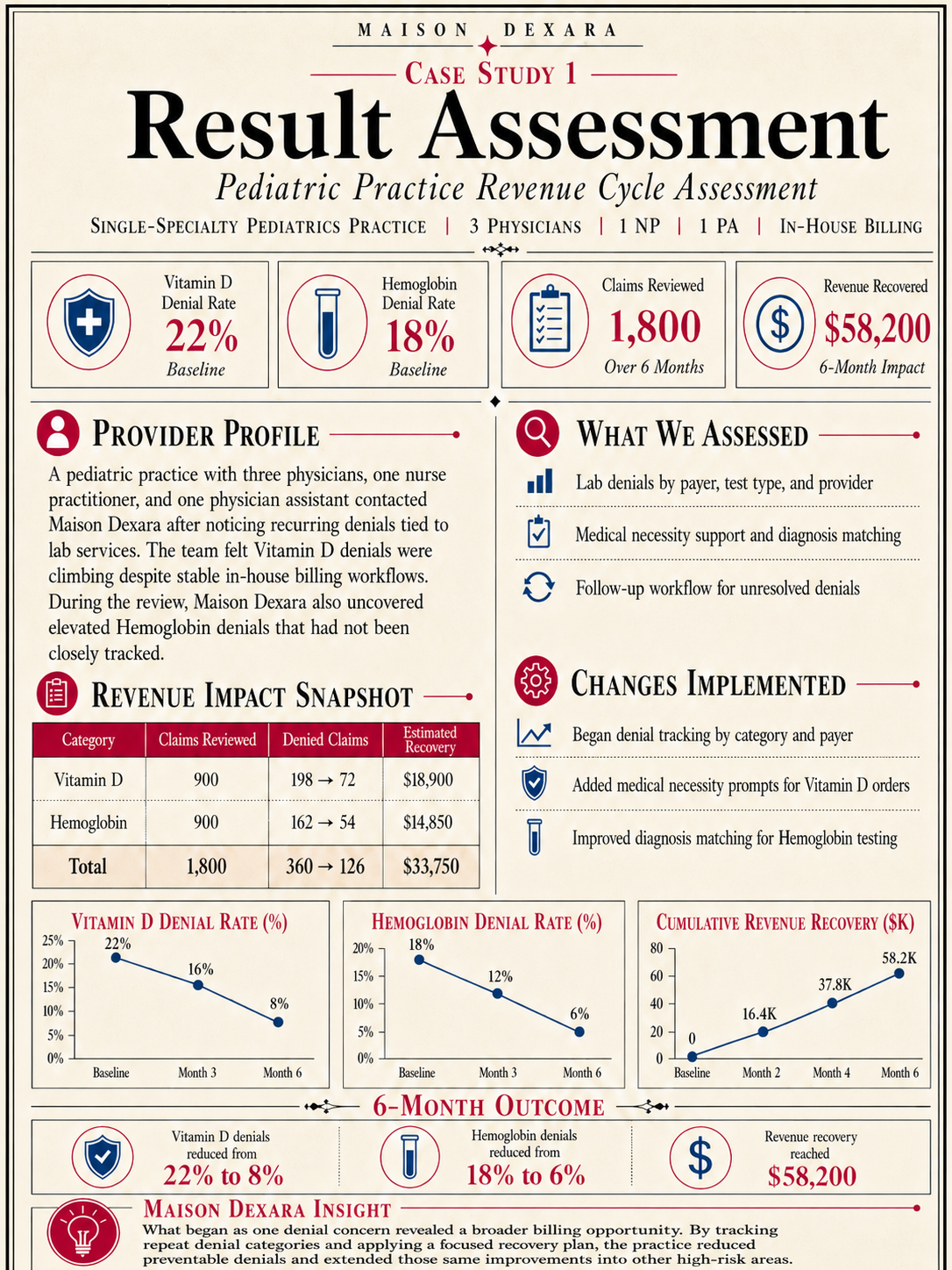
A single-specialty pediatric practice contacted Maison Dexara after noticing a steady increase in recurring denials tied to lab-related services. The practice had an in-house billing process that was generally performing well, but over time the team began feeling that Vitamin D denials and corrections were becoming more frequent. At first, the concern seemed isolated. A denied Vitamin D lab here, a corrected claim there, and another payer request added to the follow-up list. Over time, however, the pattern became harder to overlook.
During the assessment, Maison Dexara confirmed that the practice’s concern was valid. Vitamin D denials were elevated, with an initial denial rate of 22%. This type of denial pattern can occur when lab testing is not clearly supported by documentation, diagnosis matching or payer-specific medical necessity requirements. Vitamin D testing can be especially payer-sensitive because many policies do not treat routine screening the same as testing supported by documented risk factors, symptoms or qualifying clinical circumstances. As the review continued, Maison Dexara also uncovered a second concern that had not been closely tracked. Hemoglobin-related denials were also trending high, with an initial denial rate of 18%. This gave the practice a broader view of the issue. What first appeared to be one denial concern was actually part of a larger lab-related billing pattern.
Maison Dexara’s review found that the issue was not simply “too many denials.” The deeper concern was that the same denial categories were repeating over time, which meant the billing team was often correcting issues after the claim had already been submitted. The recommended next step was to begin tracking denial patterns by payer, test type and reason code, then implement a focused recovery plan around documentation prompts, diagnosis matching and follow-up workflow. Over the course of six months, Vitamin D denials were reduced from 22% to 8%, and Hemoglobin denials were reduced from 18% to 6%. Across 1,800 reviewed claims, denied claims in these two categories decreased from 360 to 126. The direct estimated recovery tied to these categories was $33,750, and the broader six-month recovery effort reached $58,200 as the same process improvements were applied to other high-risk areas of the practice.
With an estimated service investment of approximately $22,000 over the same six-month period, the practice recovered more than the cost of the engagement while also gaining a clearer process for preventing the same issues from continuing. The value was not only in the revenue recovered. It was in helping the practice understand where earned revenue was being delayed, where the team needed better front-end support and how one repeated denial concern could uncover a larger opportunity to strengthen the revenue cycle.
〰️
〰️
Case Study 2: Behavioral Health Revenue Cycle Assessment and Monthly Monitoring Results
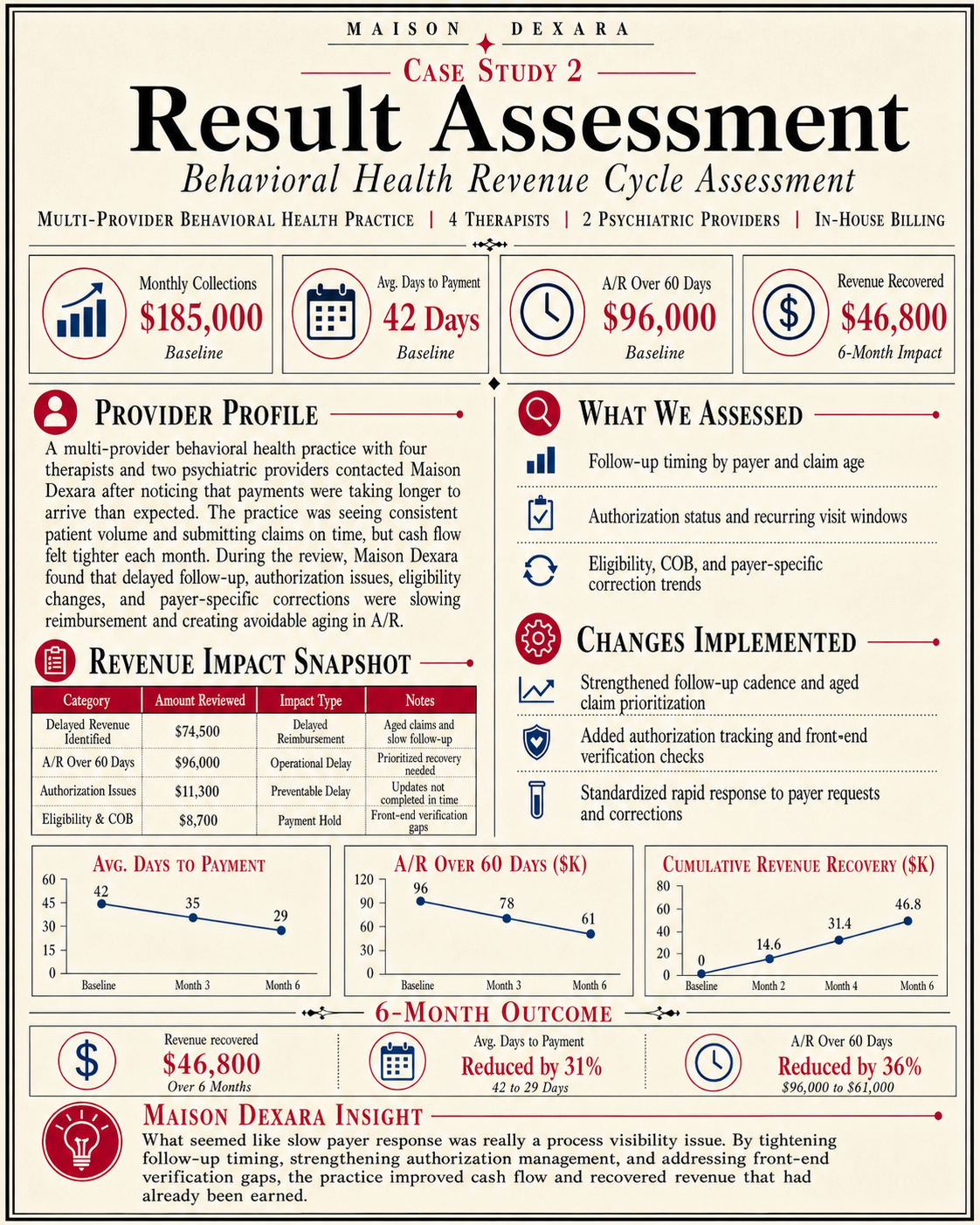
A multi-provider behavioral health practice with four therapists and two psychiatric providers contacted Maison Dexara after realizing that consistent patient volume was not creating the cash flow they expected. The practice was busy, appointments were steady, and claims were being submitted through an internal billing process. Even so, payments were arriving later than anticipated, and each month began to feel tighter than the last. What made the issue difficult was that nothing appeared obviously broken at first. The team was doing the work and following the process, but reimbursement was not moving with the same steadiness as patient care.
Maison Dexara’s assessment began by looking at where payments were slowing down and how long claims were remaining unresolved. The review identified approximately $74,500 in delayed revenue that needed closer prioritization. The practice also had $96,000 in accounts receivable over 60 days, with an average payment timeline of 42 days. Some claims were waiting on authorization updates, while others were delayed by eligibility changes, coordination-of-benefits concerns, payer-specific correction requests, and follow-up timing that was not consistently tied to claim age or balance. For a behavioral health practice, where recurring visits and authorization windows can shift quickly, these small delays had created a much larger cash-flow concern.
The review showed that the issue was not simply “slow payers.” The deeper concern was that delayed claims were not always visible soon enough for the team to act before aging increased. Maison Dexara recommended a stronger follow-up cadence, a clearer process for aged claim prioritization, improved authorization tracking, and front-end verification checks to reduce preventable payment holds. The practice also implemented a quicker response workflow for payer requests and corrections, giving the billing team a more structured way to move claims forward instead of reacting only after delays became more serious.
Over the course of six months, the practice reduced average days to payment from 42 days to 29 days. A/R over 60 days decreased from $96,000 to $61,000, and delayed claims were reduced by approximately 31%. These improvements contributed to $46,800 in revenue recovery while giving the practice a clearer view of where payments were being held and why. The value was not only in recovering delayed revenue. It was in helping the practice protect cash flow, reduce preventable aging, and build a more predictable process for reimbursement moving forward.
〰️
〰️
Case Study 3: Specialty Practice Revenue Cycle 90- Day Assessment
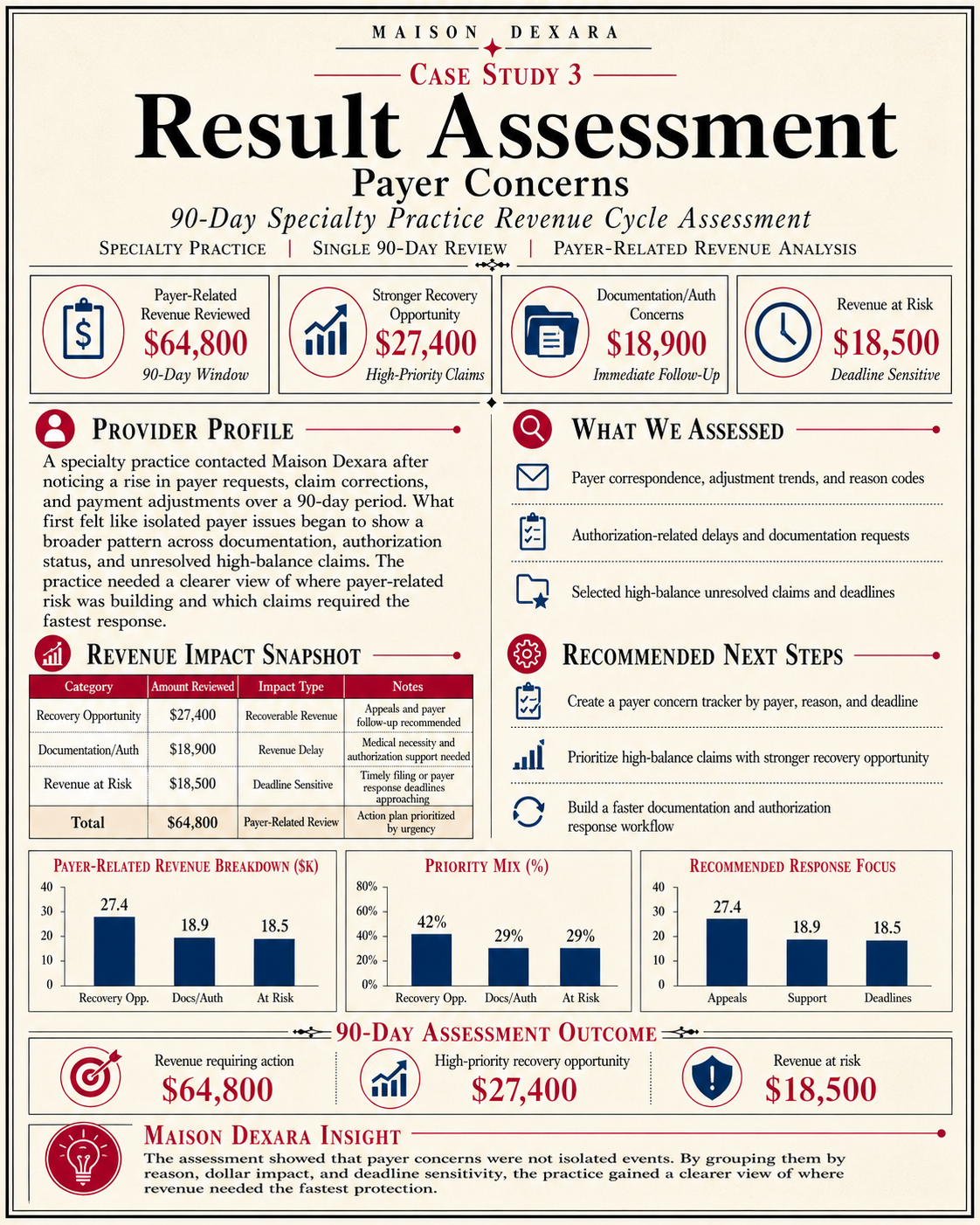
Maison Dexara was brought in after the practice started noticing an increase in payer-related concerns over a 90-day period. The practice was receiving more requests for additional documentation, more claim corrections, and more notices tied to medical necessity, authorization status, and payment adjustments. At first, the concerns did not appear connected. One payer requested records on a higher-balance claim, another adjusted payment after review, and a few claims required corrected information before they could move forward. Over time, however, the pattern began to feel less like ordinary payer communication and more like a sign that revenue needed closer protection.
Our 90-Day Billing Activity Assessment identified $64,800 in payer-related revenue that needed additional attention. Of that amount, approximately $27,400 was tied to claims with a stronger recovery opportunity, while $18,900 was connected to documentation or authorization concerns that required immediate follow-up. Another $18,500 was considered revenue at risk because the claims were approaching timely filing, appeal, or payer response deadlines. CMS guidance notes that prior authorization and pre-claim review processes require the same information needed to support payment earlier in the process, which makes documentation readiness especially important when payer concerns begin to increase.
Maison Dexara’s review found that the issue was not simply “difficult payers.” The deeper concern was that payer issues were being handled one at a time, without a clear system for grouping them by payer, reason, dollar impact, and deadline sensitivity. Some claims needed stronger documentation support. Others needed authorization verification, corrected claim review, or faster response to payer requests. CMS also defines improper payments as payments that do not meet program requirements, including overpayments, underpayments, or payments where insufficient information was provided to determine whether payment was proper. That means payer concerns are not always about fraud or serious wrongdoing. Sometimes they reveal missing administrative steps, unclear documentation, or process gaps that can be corrected before they become larger financial concerns.
At the close of the 90-day assessment, Maison Dexara recommended a payer concern tracker organized by payer, claim status, reason code, deadline, and estimated financial impact. The practice was also advised to prioritize high balance claims first, create a documentation response workflow, review authorization requirements before resubmission, and monitor adjustment codes more consistently through remittance review. CMS explains that remittance advice reports include claim and line-level adjudication details, including the reason and value of adjustments, which makes them an important source for understanding payer behavior and payment outcomes.
The value of the assessment was not only in identifying revenue that may be recovered. It was in helping the practice see which payer concerns required immediate attention and which patterns needed a stronger internal process moving forward. By the end of the 90-day review, the practice had a clearer view of payer-related risk, a prioritized list of claims needing action, and a practical next-step plan to protect revenue before unresolved payer concerns became avoidable write-offs or deeper reimbursement strain.
〰️
〰️
Case Study 4: Family Medicine Patient Billing Communication 60-Day Snapshot Assessment
A family medicine practice started experiencing high volumes of patients calling with questions about balances, insurance adjustments and what they owed after their visits. The practice had a steady patient base and an active billing team, but front desk staff and billing staff were spending more time walking patients through statements, explaining insurance activity and repeating the same financial conversations. At first, the issue seemed like normal patient follow-up. One patient had a deductible question, another did not understand an adjustment, and another wanted to know why a balance appeared weeks after the appointment. Over time, however, the pattern began to place pressure on both the team and the patient experience.
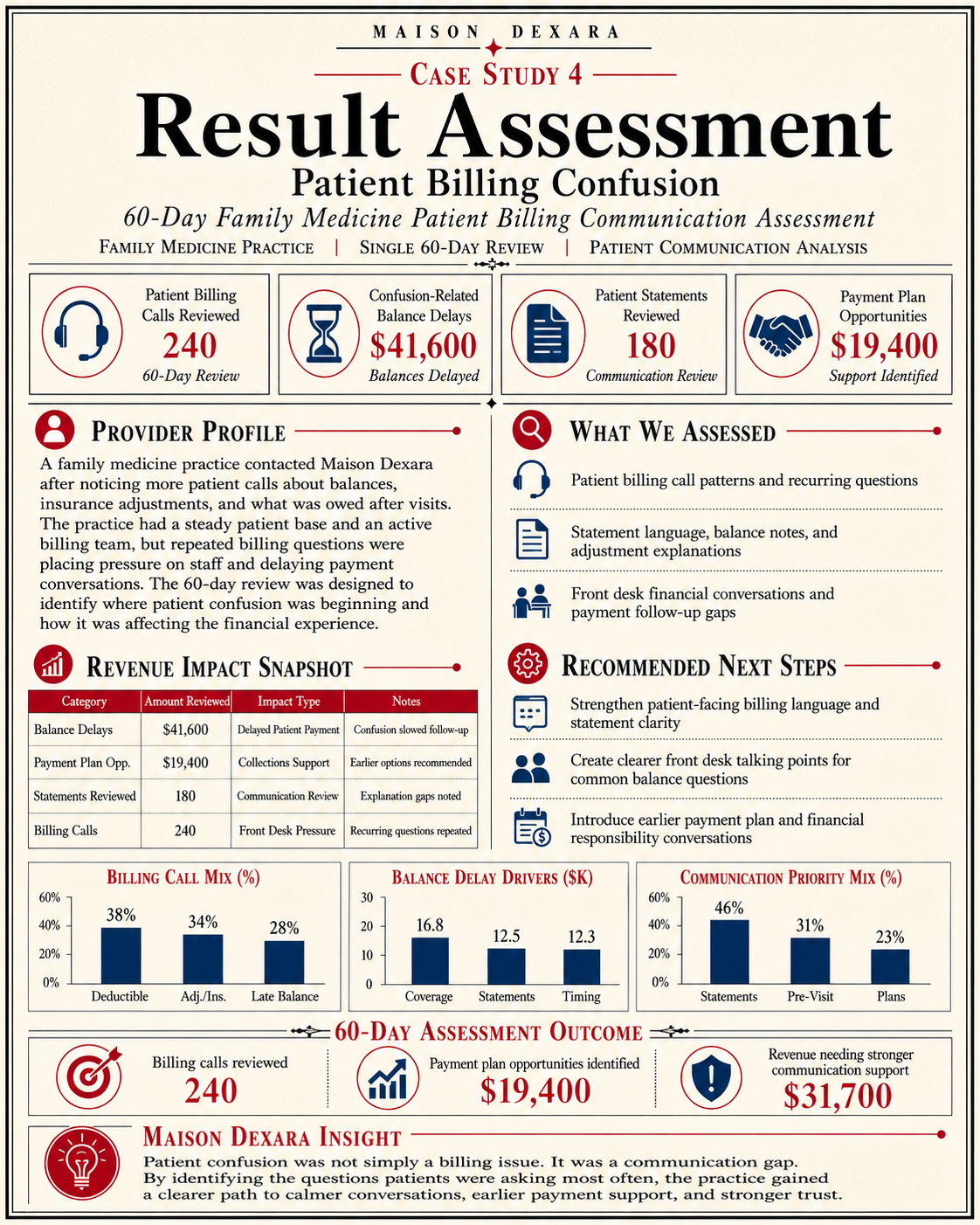
During the 60-day assessment, Maison Dexara reviewed patient billing call patterns, statement language, balance follow-up notes and common points of confusion in the patient communication process. The review found that many concerns were not rooted in patients refusing to pay. They were tied to uncertainty. Patients were unclear about deductibles, coinsurance, payer adjustments and why their insurance did not cover the full amount. The assessment also showed that some patients were receiving financial explanations too late in the process, after the visit had already taken place and after the claim had already processed. By that point, the conversation often felt reactive instead of supportive.
Maison Dexara’s review found that the issue was not simply “patients not understanding their bills.” The deeper concern was that the practice did not have a consistent process for preparing patients before balances became confusing or stressful. Across the 60-day review period, 240 patient billing calls were evaluated, and approximately $41,600 in patient balances were tied to confusion-related payment delays. Maison Dexara also identified $19,400 in accounts where earlier payment plan conversations may have helped reduce collection pressure. The recommended next step was to strengthen patient-facing billing language, create clearer front desk talking points, improve statement explanations and introduce earlier education around deductibles, coinsurance and expected financial responsibility.
After the 60-day assessment, the practice had a clearer view of where patient confusion was beginning, which conversations were repeating most often and where staff needed better support. The recommended communication improvements were designed to reduce repeat billing-related calls, shorten patient payment delays and create more consistent payment plan conversations. The estimated revenue needing stronger patient communication support totaled $31,700. The value was not only in improving collections. It was in helping the practice create a calmer financial experience for patients, reduce repeated staff explanations and protect trust before billing confusion became frustration.
〰️
〰️
Case Study 5: Primary Care 30-Day Revenue Cycle Snapshot Assessment
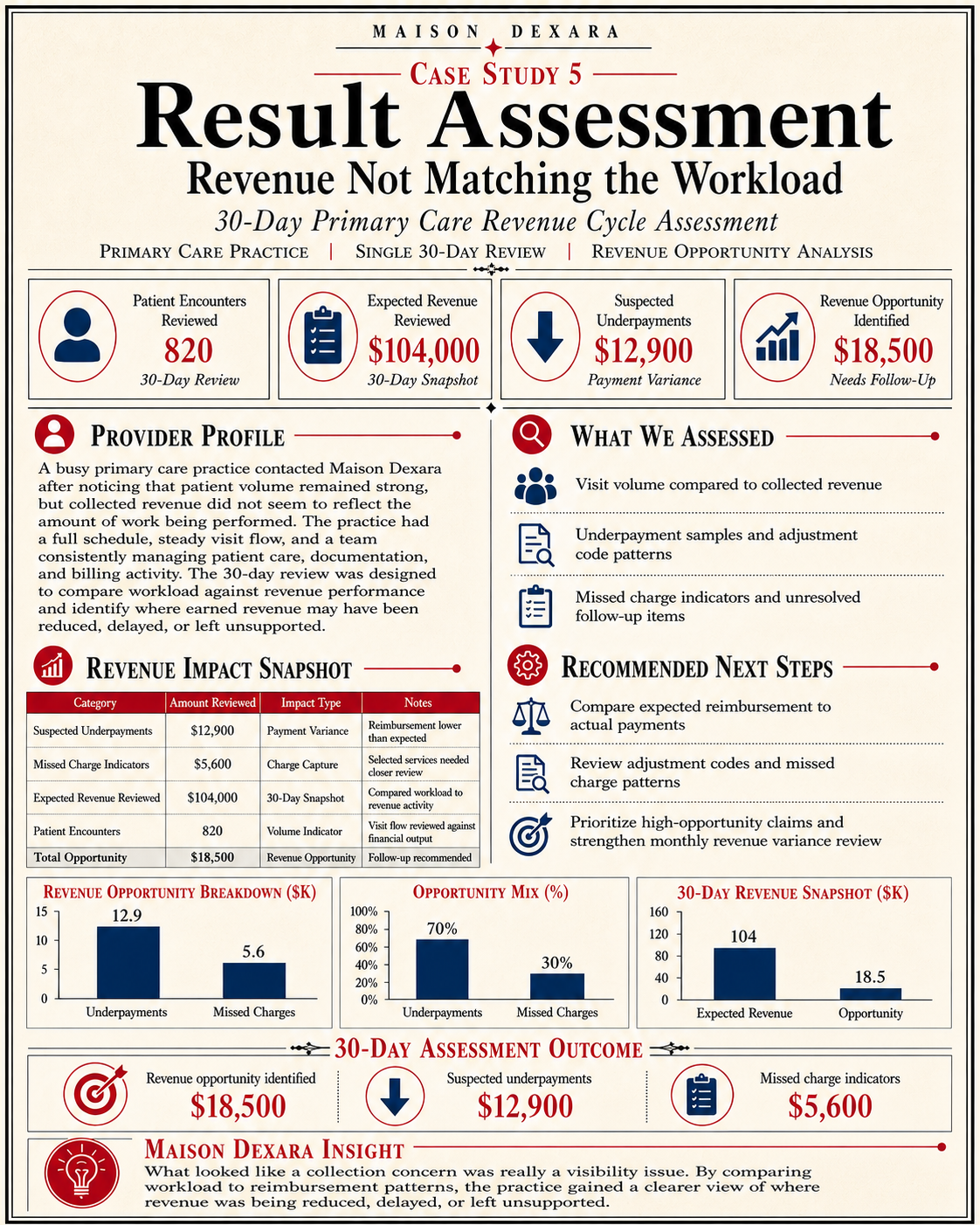
A busy primary care practice contacted Maison Dexara after noticing that patient volume remained strong, but collected revenue did not seem to reflect the amount of work being performed. The practice had a full schedule, steady visit flow and a team that was consistently managing patient care, documentation and billing activity. On the surface, the practice appeared productive. Yet leadership began to feel that the financial results were not matching the workload. The concern was not that the team was failing. The concern was that something within the revenue cycle needed a closer look.
During the 30-day assessment, Maison Dexara reviewed 820 patient encounters and approximately $104,000 in expected revenue activity. The review compared visit volume, billed charges, payment activity, adjustment patterns and selected claims where reimbursement appeared lower than expected. Several concerns began to stand out. Some claims showed suspected underpayments when actual payer reimbursement did not align with expected payment patterns. Other accounts reflected adjustment codes that needed closer review, missed charge indicators and unresolved balances that had not been prioritized for follow-up. What first felt like a broad concern about collections became a clearer picture of where earned revenue may have been reduced, delayed or left unsupported.
Maison Dexara’s review found that the issue was not simply “the practice is not collecting enough.” The deeper concern was that the practice did not have a consistent way to compare workload against revenue performance in a measurable way. A full schedule can create the appearance of financial strength, but volume alone does not confirm that claims are being paid correctly, charges are being captured completely, or payer adjustments are being reviewed appropriately. The 30-day assessment identified approximately $12,900 in suspected underpayments and $5,600 in missed charge indicators, creating a total revenue opportunity of $18,500 that warranted closer follow-up.
At the close of the 30-day assessment, Maison Dexara recommended a focused reimbursement review, payer adjustment tracking and a monthly comparison of expected revenue against actual collections. The practice was also advised to prioritize high-opportunity claims, review missed charge patterns and create a clearer process for identifying payment variance before it became absorbed into routine write-offs. The value of the assessment was not only in identifying possible revenue opportunity. It was in helping the practice understand why a hardworking team could still feel financially behind and where the revenue cycle needed stronger visibility to better reflect the care being delivered.